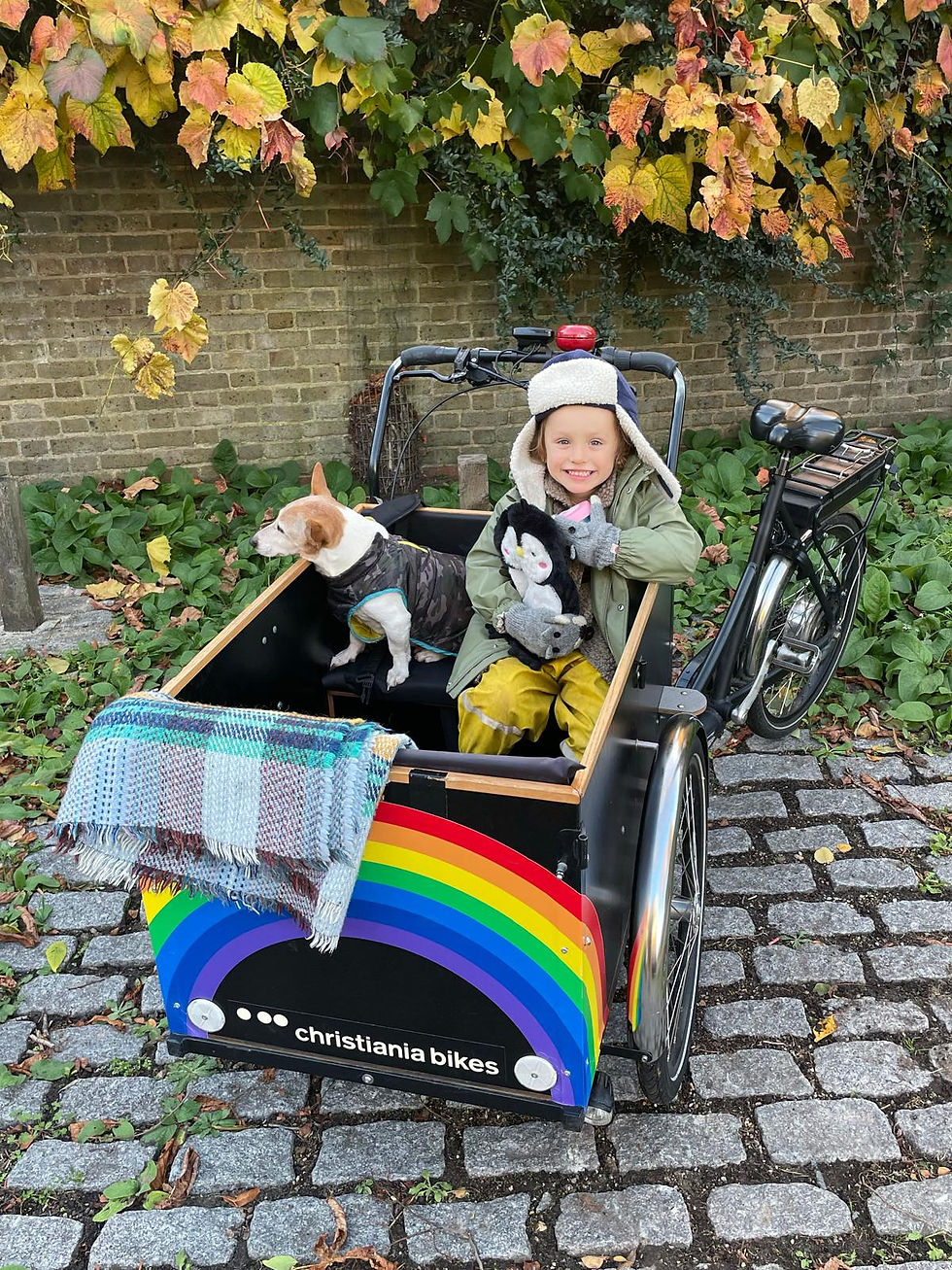
Want to save £4k during the fuel crisis? Get a cargo bike like TV's Dr Chris
- Solve The School Run

- Apr 23
- 6 min read
PRESS RELEASE -
New research shows that transporting a family is £4,000 a year cheaper by electric family cargo bike than car.
Broadcasters including Dr Chris Van Tulleken and Laura Jackson explain why every family should be able to use a cargo bike.
As fuel prices surge, families in flats or without front gardens are ‘locked out’ of cheaper travel - with only two secure cargo bike parking spaces in London.

New research shows that families can save thousands of pounds a year by ditching their car for an electric cargo bike - but many households, particularly those living in flats, cannot make the switch.
As the war in the Middle East pushes up fuel prices, Solve The School Run and Clean Cities have calculated that using an e-cargo bike and public transport for family travel is £4,000 a year cheaper than using a second-hand family car and public transport. The analysis includes purchase price, depreciation, running costs, and additional transport costs.
Since the beginning of March petrol prices have jumped 20 per cent, while the diesel spike has been even bigger, increasing by 36 per cent.
Dr Chris Van Tulleken, the BAFTA-winning TV presenter and practicing doctor, has shared his story of making the switch and is a huge advocate of family cargo e-bikes.
“We replaced our car with a cargo bike and have never looked back. It’s way cheaper and faster than a car, and our favourite way to get all three kids around London - they love it, and I love it.
It’s great for our health, our happiness, our climate and our community.”
E-cargo bikes are an increasingly popular option for those concerned about the cost of living. Clean Cities analysis of data from Transport for London shows that cargo bike journeys doubled between 2022 and 2024 and 2025 figures from the Bicycle Association show a 36% year on year increase in e-cargo bikes sales.
However, sales in the UK are way behind other European countries, with just 4,000 sold in 2022, compared with 70,000 in France and 90,000 in Germany.
The barriers include up front costs - an e-cargo bike can cost around £6,000 - and a safe place to store the bikes.
With councillors due to be elected across the country on 7 May, the researchers have found that families are being “locked out” of thousands of pounds in potential savings because of a severe shortage of secure cargo bike parking.
“We speak to hundreds of families every year who are keen to buy an e-cargo bike, but lack of secure storage stops them,” said Alper Muduroglu, CEO of Peddle My Wheels. “It means families in flats - who could benefit most from lower transport costs - are effectively locked out.”
Even in London, which often has better bike storage facilities than other parts of the country, there are just two secure spaces in on-street cargo bike hangars, one for every 4,500,000 people in the capital. There are one million parking spaces for cars.
With secure storage for just two cargo bikes in the whole of London, in a dedicated cargo bike hangar provided by Westminster City Council, families are unable to safely store their cargo bikes, which are too big for standard bike hangars.
Electric cargo bikes are increasingly used by parents for transporting primary school-aged children distances that it would be hard for them to walk, and which often end up being driven. Research has found that half of all e-cargo bike journeys replace a car journey, cutting emissions and congestion.
Laura Jackson, Broadcaster, Founder and Creative Director of Glasette said: “School runs in London rush hour used to be chaotic with three kids, until our Benno. Now we ride together on calmer routes, skipping traffic. E-cargo bikes could transform family travel, but only if boroughs back them with subsidies, secure parking, and cycle training".

Laura Jackson, Broadcaster,Founder and Creative Director of Glasette
Nicola Pastore, co-founder of Solve The School Run, a grassroots network of parents concerned about the road danger and air pollution of the school run said: “In a cost-of-living crisis, we don’t think it’s fair that families are locked out of savings in this way. Families want a practical, affordable alternative to the car. Councils set aside kerbside space to park cars, why not do the same for a form of transport that is cleaner and cheaper?”
Solve The School Run is calling on London boroughs to develop and implement strategies for secure on-street cargo bike parking, such as hangars, and introduce subsidies to make cargo bikes more accessible to families, as outlined in its Streets for Kids manifesto. They are also asking the Mayor for a London-wide strategy for family e-cargo bikes, similar to Transport for London’s freight-focused Cargo Bike Action Plan.
Although e-cargo bikes are cheaper than cars to buy and run over time, the upfront cost can be a barrier. A family-sized e-cargo bike and accessories typically cost around £6,000. Unlike cars, which are widely available through finance or leasing schemes, families often struggle to find the initial funds.
Campaigners say council support schemes – such as discounted hire programmes like the one available in Richmond – could make e-cargo bikes far more accessible and transform everyday journeys for families.
The Government’s target for 55% of children to walk or cycle to school by 2025 has been missed, and the latest National Travel Survey shows that more than one in five families are deterred from active travel by dangerous and congested roads.
Dr Ian Philips, Associate Professor at the University of Leeds added: “Cargo bikes help people keep active, do activities with family that they might not otherwise have done and they replace car trips – showing great potential for health benefits and carbon savings. Add to this the financial and convenience benefits of these bikes and you have a very strong case for cargo bikes to become a more mainstream form of family travel - as they are in other European countries.”
Caz Conneller, Clean Cities, former founder of Cyclechic and She's Electric said:
“After 17 years working in the cycling industry, particularly in the family and lifestyle market, I’ve consistently seen cost as a barrier to e-cargo bike adoption. Many women say they would love to make the switch but simply can’t afford the upfront cost. If we are serious about reducing car-use, support and subsidies must be in place to help families make healthier, more sustainable choices, that will save them money in the long run.”
Notes to Editors
Total Costs of Ownership Cargo Bike vs Car Ownership
The full analysis including methodology, analysis tables and limitations can be found here
This analysis compares the cost for a family of using an electric cargo bike as their primary form of transport versus owning and using a car. It looks at the total cost of ownership over three years for a three-seater e-cargo bike (one adult and two children) compared with a five-seater car. As well as comparing like-for-like costs based on miles travelled, the analysis factors in additional transport costs the families would incur, informed by the National Travel Survey. Because the e-cargo bike used in the comparison carries one adult and two children, the analysis is most relevant for families with one or two children.
An e-cargo bike is an electric-assisted bicycle designed with cargo areas (front or rear) to transport heavy loads, children, or passengers. This release uses the terms cargo bike and e-cargo bike interchangeably.
Additionally, the terms cargo bike parking and cargo bike storage are interchangeable, and mean cargo bike hangars. Like normal bike hangars, these are weather-resistant, secure, insurable and lockable shelters that are specially designed for cargo bikes. Due to their size and shape, most cargo bikes cannot fit in a normal bike hangar, so need a dedicated style of hangar.
This data was FOI’d for a report for the Electrify London Campaign by Clean Cities. The campaign promotes electric vehicles - from e-cargo bikes to electric vans - for climate, clean air and a healthier and more affordable London.
Run up to the election
Southwark Labour manifesto: “We will increase funding for cargo bikes, with more storage spaces and bike share schemes, to help families reduce the miles they drive.”
Southwark Green manifesto: “Install new cycle lanes, cycle hangars and more cycle parking, including for cargo bikes and adapted cycles.”
Hackney Labour manifesto: “We will look at ways to use our kerbsides more effectively, from parking for people with disabilities, managing dockless bike hires, cargo bikes”.
Streets for Kids is a Europe-wide movement led by Clean Cities, championing child-friendly mobility and car-free school streets. In just four years, this collaborative campaign has inspired 3,200 community events, mobilised over 380,000 people, and helped create 300 new car-free school streets. Through grassroots action and policy change, Streets for Kids is transforming urban spaces into safe, vibrant environments where children can walk, cycle, wheel, and play freely — building healthier, happier cities for the next generation.
Solve The School Run is a parent-led charity that combines unique data insights with experience of real-world, parent-powered solutions. Fed up with the chaos, congestion, road danger and air pollution children have to face on the school run each day, they focus on data that highlights the issues and informs the solutions. They think all families should be able to have safe, convenient and sustainable options for getting children to school. The Streets for Kids campaign page can be found here.
Clean Cities is Europe’s largest network of organisations on a mission to build public support for cities to shift from polluting cars to active, shared and electric mobility. Clean Cities is hosted by T&E.
-ENDS-